
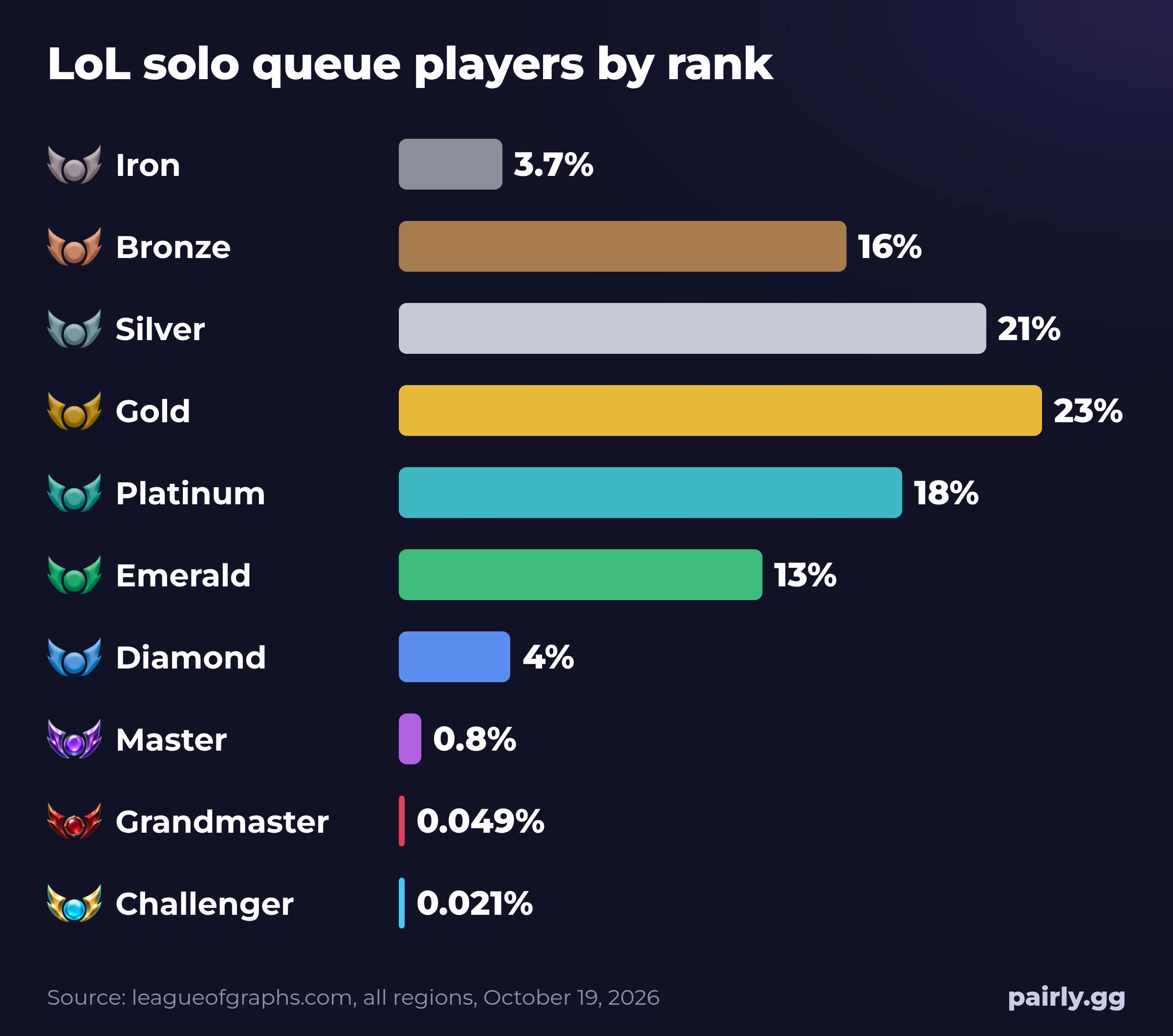
The LoL rank distribution in October 2026 peaks at Gold, with 23% of solo queue players, and the median player is Gold III. Reach Diamond IV and you are in the top 4.9%. Reach Master and you are in the top 0.9%, the group that also holds every Grandmaster and Challenger.
Those figures come from LeagueOfGraphs's rank distribution page, read on October 19, 2026, for solo queue on all regions: 17,075,879 ranked players. The page shows tier shares to two significant figures, so we added the cumulative columns ourselves. Headline figures in the text are rounded to one decimal, and the table keeps two so you can follow the sums. Rounding error builds as the sums get longer: a few hundredths near Master, a few tenths of a point by Gold, and up to about 0.7 points in the worst case at the bottom of the table. The median call below survives that. Season 3, the "Split 3" of our guide, began with patch 26.15 in late July, and our Split 3 end date guide covers when it closes.
Key takeaways
- Gold is the largest tier at 23%, then Silver at 21% and Platinum at 18%.
- The median solo queue player is Gold III. Platinum IV or higher is about 36.7% of players and Emerald IV or higher about 18.4%.
- Diamond IV or higher is about 4.9% and Master or higher about 0.9%. Riot caps Challenger at 300 and Grandmaster at 700 players in NA, EUW and KR.
- Riot said in March 2026 that it had moved players out of Iron, which it put at "around 14% of players globally" before. LeagueOfGraphs now shows 3.7%, from a different source and method.
- LeagueOfGraphs publishes no method note and no update time. Riot publishes no current distribution.
What Is the LoL Rank Distribution in October 2026?

LeagueOfGraphs lists "% of ranked players" for every tier and division, split by queue and region (LeagueOfGraphs, Rank distribution, October 19, 2026). For solo queue on all regions it looks like this:
 Iron
 Bronze
 Silver
 Gold
 Platinum
 Emerald
 Diamond
 Master
 Grandmaster
 Challenger
Silver, Gold and Platinum hold 62% of players. Emerald is 13%, the fifth-largest tier. Everything from Master up is under 1%.
What Percent of Players Are in Each LoL Rank?
League has four divisions per tier below Master, and Master, Grandmaster and Challenger have none. Riot's own words: "Tiers Iron through Diamond each have four divisions" (Riot Games Support, Ranked Tiers, Divisions, and Queues). The LoL rank percentages below add the cumulative column, "at or above", which is the "top X%" you are looking for.
Diamond IDiamond IIDiamond IIIDiamond IVEmerald IEmerald IIEmerald IIIEmerald IVPlatinum IPlatinum IIPlatinum IIIPlatinum IVGold IGold IIGold IIIGold IVSilver ISilver IISilver IIISilver IVBronze IBronze IIBronze IIIBronze IVIron IIron IIIron IIIIron IVThe last row passes 100% because every input was rounded, which shows the error at its largest: 0.07 points. Diamond III (0.6%) is smaller than Diamond II (1.3%) and Diamond IV (1.4%) on the page, and we copied the values as shown.
Three things stand out:
- Gold IV is the single biggest division at 8.2%, with Platinum IV right behind at 7.3%. From Bronze to Diamond, division IV is the largest in every tier. Iron runs the other way, with Iron I at 1.8% and Iron IV at 0.45%.
- Emerald IV or higher is about 18.4%. That is roughly the top 18% of players.
- Master is 0.87% together with Grandmaster and Challenger. Riot's Ranked Tiers page says a Master player is "in the top .2% of players worldwide". We can't reconcile that with LeagueOfGraphs's 0.87% for Master and above, and we don't know why they differ. Riot's page is dated May 2026, after the March MMR change.
What Is the Average Rank in League of Legends?
The median rank is Gold III. About 52% of players are Gold III or higher, and about 46% are Gold II or higher, so the 50% mark falls inside Gold III. The rounding error would have to exceed 1.6 points to move it, and the worst case is about 0.7. We computed the median, not the mean. Esports Tales, which publishes monthly solo queue numbers for all regions, lists Gold at 24% in August 2026 (Esports Tales, LoL rank distribution in August 2026, August 12, 2026), one point above LeagueOfGraphs.
The most common tier is Gold at 23%. The most common single division is Gold IV at 8.2%.
What Riot Changed in LoL's MMR-to-Rank Mapping
On March 2, 2026, Riot published a dev post on the MMR-to-rank mapping. It describes three changes:
- Fewer experienced players in Iron. Riot wrote: "we chose to adjust the MMR-to-Rank correlation to get the more experienced players out of Iron and into Bronze." It put Iron at "around 14% of players globally" before the change (Riot Games, /dev: MMR-to-Rank Distribution, March 2, 2026).
- Top Diamond goes to Master. "We decided to re-assign the MMR-to-Rank distribution to put players at the higher end of Diamond into Master."
- Apex LP goes up. "It has made the LP requirements for Grandmaster and Challenger higher, even though there's the same number of players there."
LeagueOfGraphs now shows Iron at 3.7%, and Esports Tales shows 3.4% in August. Riot's post doesn't give a date or list the regions for the change, so we can't say when each region moved.
Riot fixes the size of the top. Its Master, Grandmaster and Challenger page lists a maximum of 700 Grandmaster and 300 Challenger players in North America, Europe West and Korea (Riot Games Support, Master, Grandmaster, and Challenger, May 30, 2026). LeagueOfGraphs lists Challenger at 0.018% of 1,655,676 players in North America, 0.0081% of 3,716,969 in Europe West and 0.0092% of 3,263,315 in Korea, which come to about 298, 301 and 300 players. That is our arithmetic, not a LeagueOfGraphs figure. It suggests the page counts the full top of the ladder. Our Challenger and Grandmaster cutoffs post shows the LP those seats took.
LoL Rank Distribution by Region
LeagueOfGraphs publishes a page per region. For North America, Europe West and Korea, the tier shares from Platinum down differ from the all-region numbers by about a point at most, and the table below shows where the regions part ways at the top.
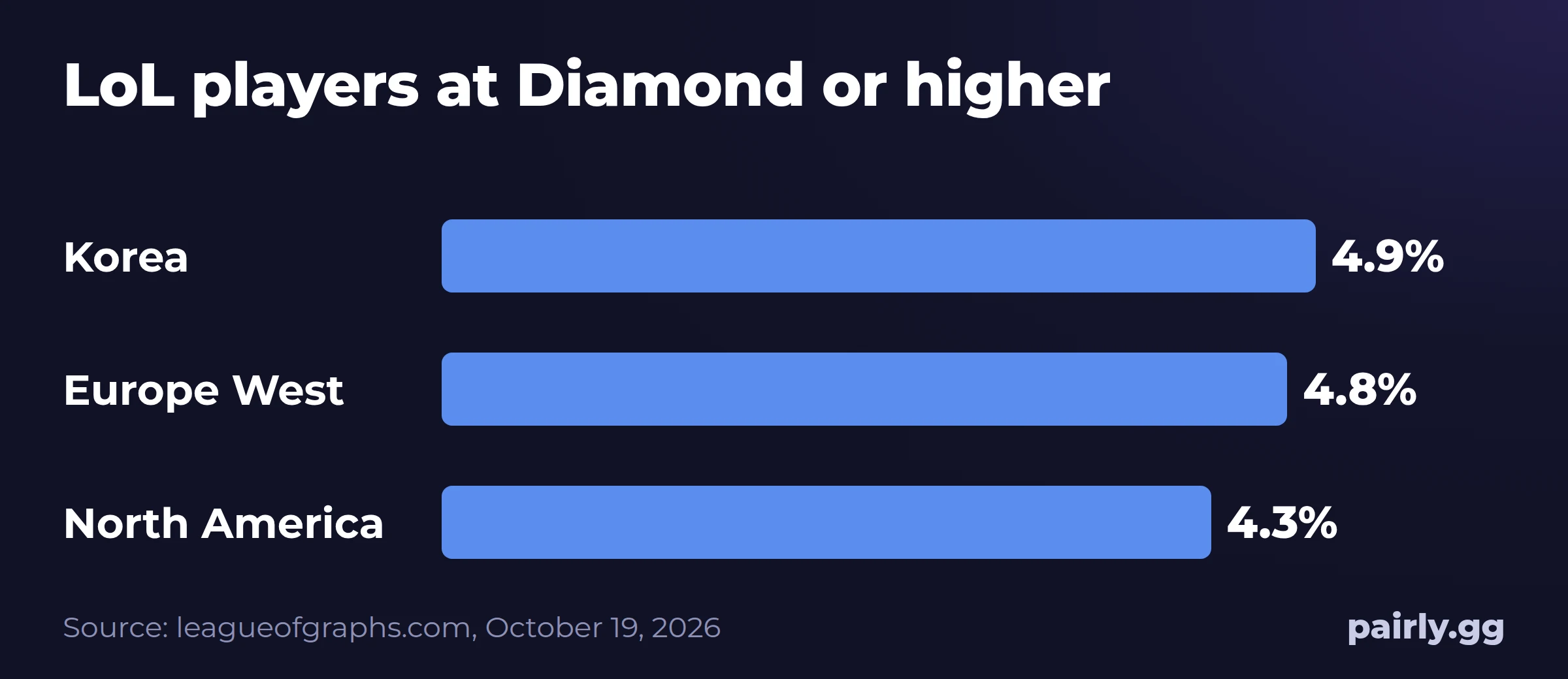
Of the three regions we read, Korea has the highest share at Diamond or higher and the lowest at Master or higher. North America has the smallest Diamond-or-higher share, 4.34% against 4.93% in Korea. That gap of 0.59 points is small next to the gaps between tiers, but it is only a few times the rounding error, so don't lean on it. We did not read the other regions.
Where the LoL Rank Data Comes From
LeagueOfGraphs gives no method note on the rank distribution page, and no update time. The page header reads "Patch: 16.20", which is LeagueOfGraphs's own label. Riot's patch for the same period is 26.20. The page shows a PLAYERS count for each region, 17,075,879 for all regions.
Three limits apply:
- It isn't Riot's data. LeagueOfGraphs states it isn't endorsed by Riot. We found no current rank distribution from Riot itself.
- The method is undocumented. We can't say which accounts are counted, or how often.
- It's a snapshot. It was read on October 19, 2026. Our percentages are arithmetic on the site's rounded shares.
Esports Tales's August 2026 table is close to LeagueOfGraphs's where we compared them: Gold at 24% against 23% and Iron at 3.4% against 3.7%. We can't say whether the two draw on the same data. Tables written before March 2026 predate Riot's MMR change, which by Riot's account moved players out of Iron, so they should show more Iron.
What Does the Distribution Mean for Your Climb?
- Gold IV and Platinum IV are the biggest divisions. Gold IV holds 8.2% and Platinum IV 7.3%.
- Emerald is a large tier. At 13%, it holds more than Diamond, Master, Grandmaster and Challenger put together (about 4.9%).
- Diamond starts at the 95th percentile. About 4.9% of LoL players are Diamond IV or higher, and Diamond I is the top 1.55%.
- Master and above is a capped group. Riot limits Grandmaster and Challenger seats per region, so your place in those two tiers also depends on how many players sit above you, on top of your LP.
The mechanics behind these tiers are in our LP and MMR guide, and the rules for duo queue by rank and flex queue change as you climb.
If you want to skip a stretch of the ladder, the LoL boosting page shows the price as you pick your current and target rank, and coaching has a high-rank coach watch your stream and talk you through your games. Boosting on your account breaks Riot's Terms of Service and Riot runs detection. Read our guide to LoL boosting risks and account security before you order anything.
Recent Trustpilot reviews, quoted as written:
- Rated 5 out of 5.
“Good site and capable boosters”
- Rated 5 out of 5.
“The tbh best new boosting site and really so Imprrssive design of that. We won with pracmarin 8 games out of 10. Realy recommend”
Every Pairly service, by game:
LoL Rank Distribution FAQ
What percent of LoL players are Diamond or higher?
About 4.9% on LeagueOfGraphs's all-region solo queue data, October 19, 2026. That is Diamond IV or any higher rank. It is 4.34% in North America and 4.93% in Korea.
What percent of LoL players are in Master or higher?
About 0.9%. That includes Master at 0.8%, Grandmaster at 0.049% and Challenger at 0.021%.
What is the most common rank in League of Legends?
Gold, at 23% of solo queue players. The most common single division is Gold IV at 8.2%.
Is Gold III the median rank in League of Legends?
Yes, in this data. About 52% of players are Gold III or higher and about 46% are Gold II or higher, so the middle falls inside Gold III. We did not compute a mean.
How many players are in Iron now?
3.7% on LeagueOfGraphs and 3.4% on Esports Tales in August 2026. Riot said Iron held around 14% of players before its March 2026 change.
Does Riot publish the official rank distribution?
We found no current rank distribution from Riot. Its March 2, 2026 dev post gives one number, the old Iron share. Third-party sites such as LeagueOfGraphs estimate the rest.
Why do different sites show different LoL rank distributions?
Possible reasons are different dates and methods that the sites don't document. Tables written before March 2026 also predate Riot's MMR change, so by Riot's account they should show more Iron and fewer Master players.
The Short Version
In October 2026, the LoL ladder peaks at Gold with 23% of solo queue players, and the median player is Gold III. Diamond IV or higher is about 4.9% and Master or higher about 0.9%. Riot said in March that it moved players out of Iron and pulled the top of Diamond into Master. Among the three regions we read, the Diamond-or-higher share differs by about half a point, highest in Korea and lowest in North America. The numbers come from LeagueOfGraphs, not Riot, and their rounding error grows down the table, so use them to place yourself, not to settle an argument.